
The Complete Guide to REM Sleep — What It Is and Why You Need It
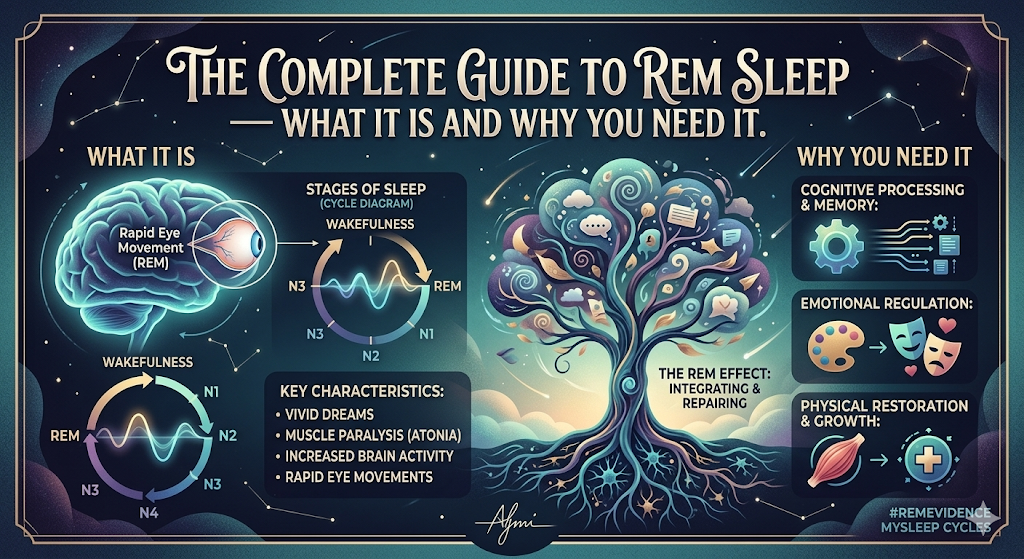
Every night, something remarkable happens while you sleep. Your brain becomes nearly as active as when you are awake. Your eyes move rapidly beneath your eyelids. Your muscles are temporarily paralysed. And your brain processes everything that happened during the day — consolidating memories, regulating emotions, and making creative connections between ideas.
This is REM sleep. And it may be the most important stage of sleep you are not getting enough of.
What Is REM Sleep?
REM stands for Rapid Eye Movement — named for the characteristic rapid movement of the eyes under closed lids during this sleep stage. It was first described by researchers Nathaniel Kleitman and Eugene Aserinsky at the University of Chicago in 1953, and it fundamentally changed how scientists understood sleep.
REM sleep is one of four stages in the sleep cycle. The others — N1 (light sleep), N2 (core sleep), and N3 (deep slow-wave sleep) — are collectively called NREM (non-rapid eye movement) sleep. A complete sleep cycle lasts approximately 90 minutes and cycles through all four stages.
What makes REM uniquely different from the other stages:
Brain activity: During REM, EEG recordings show brain waves that look almost identical to wakefulness. The brain is highly active, consuming almost as much glucose as it does when you are conscious and thinking.
Physical paralysis: Your voluntary muscles are temporarily immobilised during REM — a phenomenon called atonia. This prevents you from physically acting out your dreams. People with REM sleep behaviour disorder, where this paralysis fails, can injure themselves or their partners during sleep.
Dreaming: Most vivid, narrative dreaming occurs during REM sleep, though some dreaming also occurs during N2. This is why you are more likely to remember a dream if you wake during or just after REM.
Eye movement: The cause of the characteristic rapid eye movements remains debated, but current research suggests the eyes may be tracking visual imagery in dreams, or that the movements reflect the activation patterns of visual brain areas.
When Does REM Sleep Occur?
REM sleep does not occur uniformly throughout the night. The distribution of sleep stages shifts significantly as the night progresses.
In your first two sleep cycles (the first three hours of sleep), very little REM occurs — perhaps 10 minutes per cycle. Most of the early night is devoted to N3 deep sleep, which is critical for physical recovery and immune function.
As the night continues, the proportion of REM in each cycle increases substantially. By your fifth cycle (around 7 to 8 hours of sleep), a single cycle may contain 45 to 60 minutes of REM. This is why the final hours of sleep are disproportionately important for REM.
This is also why cutting sleep short is so damaging to REM in particular. If you sleep 6 hours instead of 7.5, you lose a disproportionate amount of REM sleep — the stages concentrated in the last 1.5 hours of the night. This is a key reason many people wake up tired after 8 hours if they don't hit their cycle boundaries.
What REM Sleep Does for Your Brain and Body
The functions of REM sleep are among the most actively researched areas in neuroscience. What we know so far is remarkable.
Memory Consolidation and Learning
During REM sleep, the brain replays and consolidates information acquired during the day. Specifically, REM appears critical for the consolidation of procedural memory (how to do things — skills, motor sequences) and emotional memory (experiences with an emotional charge).
Studies have shown that people who sleep after learning a new skill perform significantly better on subsequent tests than those who stay awake. People deprived of REM sleep specifically show impaired learning retention even when total sleep time is preserved.
Matthew Walker, professor of neuroscience at the University of California Berkeley and author of Why We Sleep, has described REM sleep as "first aid for the emotional brain" — a nightly therapy session where the brain processes the emotional weight of experiences from the previous day.
Emotional Regulation
The amygdala — the brain's emotional processing centre — is particularly active during REM sleep. Research suggests that during REM, emotionally charged memories are reactivated and reprocessed in a neurochemical environment free of noradrenaline (the stress hormone), allowing the emotional tone to be stripped from memories while retaining the information itself.
This is why a problem often seems more manageable after sleeping on it. REM sleep appears to take the sharp edges off emotional experiences, a process sometimes called "overnight therapy."
People deprived of REM sleep show heightened emotional reactivity, increased anxiety, reduced ability to read social cues, and greater difficulty regulating negative emotions. Chronic REM deprivation is associated with increased risk of depression and anxiety disorders.
Creativity and Problem-Solving
REM sleep is associated with the formation of novel connections between distantly related concepts — a process that underlies creative insight and problem-solving. During REM, the hippocampus (which stores recent experiences) communicates with the neocortex (which stores long-term knowledge) in ways that do not occur during wakefulness.
Studies have shown that subjects are significantly more likely to discover hidden rules in complex tasks after sleeping — particularly after REM-rich sleep — than after equivalent periods of wakefulness. The classic experience of waking with a solution to a problem that eluded you the night before is a real phenomenon rooted in REM sleep neuroscience.
How Much REM Sleep Do You Need?
Adults typically spend 20 to 25% of their sleep time in REM — approximately 90 to 120 minutes for someone sleeping 7.5 to 8 hours. This decreases slightly with age: older adults spend closer to 15 to 20% of sleep in REM.
Use our REM Sleep Estimator to calculate how much REM sleep you are getting based on your age and sleep duration.
What Reduces REM Sleep?
Several common factors specifically suppress REM sleep:
Alcohol: Even moderate alcohol consumption before bed significantly reduces REM sleep, particularly in the first half of the night. This is one reason why alcohol-disrupted sleep feels unrefreshing even when total sleep time is adequate.
Cannabis (THC): THC suppresses REM sleep. Long-term cannabis users often experience intense, vivid dreaming when they stop using — known as REM rebound — as the brain catches up on suppressed REM.
Antidepressants: Many antidepressants, particularly SSRIs and SNRIs, significantly suppress REM sleep as a side effect. This is an important consideration in treatment planning and should be discussed with a prescribing doctor.
Sleep deprivation: Paradoxically, chronic sleep deprivation causes selective REM deficiency because REM is concentrated in the later cycles that are cut short. However, when sleep debt is recovered, the brain prioritises REM sleep — a phenomenon called REM rebound.
Sleep apnea: The repeated arousals caused by sleep apnea frequently interrupt REM sleep, since the muscle relaxation of REM makes airway obstruction more likely.
How to Increase REM Sleep
The most effective ways to protect and increase REM sleep:
Sleep longer. Since REM is concentrated in the final cycles, extending total sleep time is the single most effective intervention. Going from 6 hours to 7.5 hours dramatically increases REM.
Maintain a consistent schedule. A regular sleep-wake schedule keeps your circadian rhythm aligned so REM sleep occurs at the expected time.
Limit alcohol, especially in the evening. Even one drink can reduce REM in the first half of the night.
Reduce stress before bed. High cortisol levels can suppress REM. A wind-down routine that includes relaxation reduces cortisol.
Address sleep apnea. If you snore heavily or wake frequently, speak to your GP about a sleep study.
Use our Sleep Calculator to ensure you are sleeping long enough to complete adequate REM cycles.
Frequently Asked Questions
Related Calculators
The information in this article is for educational purposes only and does not constitute medical advice. If you have concerns about your sleep quality, please speak to your GP.