
How to Use a Bedtime Sleep Calculator for Better Rest
By Sue Worrall · Published 19th June 2026
If you've ever had one of those mornings where you've technically slept long enough, but still feel like you've been hit by a bus overnight, you're not alone.
It usually comes down to timing. Not just how long you sleep, but where you land in your sleep cycle when your alarm goes off.
That's where a bedtime sleep calculator comes in. It's not magic and it won't fix bad sleep on its own, but it does help you line things up a bit better than guessing. You can try a simple version of one here: Bedtime Calculator.
And yes, I know "calculator" sounds a bit clinical. It's really just a simple way of working out when you should go to bed so you're not waking up at the worst possible point in your sleep.
What a Bedtime Sleep Calculator Actually Does
At its core, a bedtime sleep calculator is just working backwards from the time you need to wake up.
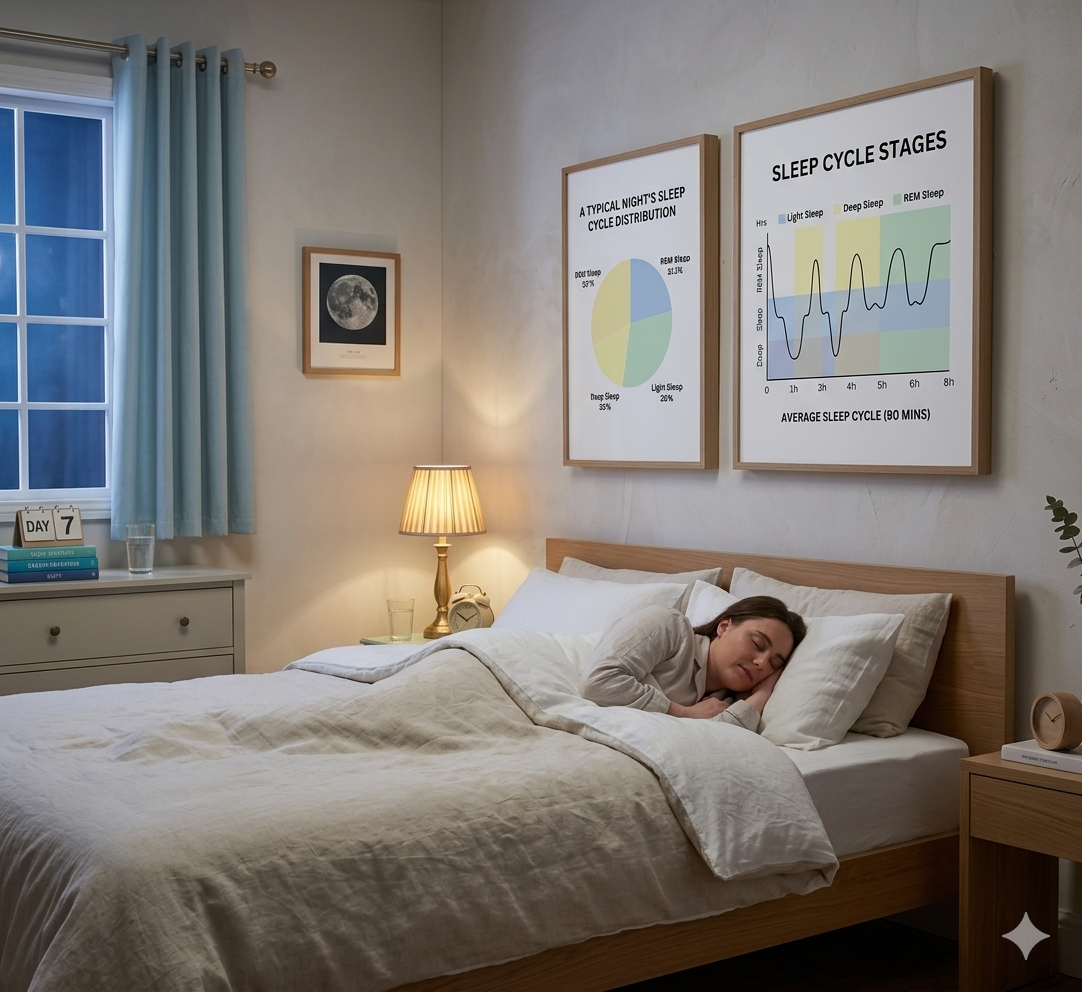
It assumes your sleep runs in cycles of around 90 minutes. You don't sleep in one flat block. You move through lighter sleep, deeper sleep, then REM sleep, and then it loops again. You can read more about that here: Sleep Cycles.
Most people go through about five or six of these cycles a night.
So the calculator takes your wake-up time, subtracts full 90-minute chunks, and then adds a bit of buffer for the time it takes you to actually fall asleep. Most people need around 10 to 15 minutes for that.
If you want a full breakdown of how this works in practice, this page explains it in more detail: Sleep Calculator.
Sleep Cycles and Why They Matter
A full sleep cycle is usually around 90 minutes, though it can vary a bit from person to person.
Within each cycle, your brain moves through different stages:
- Light sleep at the start
- Deeper sleep where your body does most of its physical repair
- REM sleep where dreaming happens and your brain processes information
You can read a deeper explanation of REM sleep here: REM Sleep.
What matters most is when you wake up.
If your alarm hits during deep sleep, you often feel groggy and slow. That heavy fog can hang around for a while. That is sleep inertia.
If you wake at the end of a cycle, you usually feel more alert, even if the total sleep time is the same.
How to Work Out Your Own Bedtime
You do not really need a tool. You can work it out yourself.
Start with your wake-up time.
Then work backwards in 90-minute blocks.
Most adults aim for:
- 5 cycles (about 7.5 hours)
- 6 cycles (about 9 hours)
Then add around 15 minutes for falling asleep.
So if you need to wake at 7am and you are aiming for 5 cycles:
You land at about 11.30pm asleep time.
Add 15 minutes and you are closer to 11.15pm in bed.
If you want to try different wake-up times quickly, this tool does the maths for you: Sleep Calculator.
How Much Sleep You Actually Need
This varies more than people think.
General guidelines look like this:
- Adults: around 7 hours or more
- Teenagers: 8 to 10 hours
- School-age children: 9 to 12 hours
- Younger children: often more, sometimes including naps
You can read more about how these ranges are calculated here: Methodology.
Most adults sit somewhere between 4 and 6 full cycles.
Five cycles is a common middle point. Some people feel better on six. Others get by on four, though that is less common long term.
Why Consistency Matters More Than Perfect Timing
One good night does not change much.
What tends to matter more is repeating the same pattern.
If your bedtime changes every night, your sleep tends to feel less stable. You might still fall asleep, but the quality shifts around.
A sleep calculator gives you a target. The real challenge is sticking to it.
Screens often make this harder than expected. Even short periods of scrolling can push your sleep timing later than you planned.
If you often wake up feeling tired even after a full night, this might explain it: Why Do I Wake Up Tired After 8 Hours?.
A Few Practical Adjustments That Help
Nothing complicated here. Just small things that make it easier to stick to a rhythm:
- Keep your wake-up time steady
- Give yourself a short wind-down before bed without screens
- Do not stress if you miss your target by a little
- Pay attention to how you feel over several days, not just one night
If your sleep pattern feels out of sync, this guide might help: How to Fix Your Sleep Schedule.
A Note on Naps
Sleep cycles do not just matter at night.
A short nap of around 20 minutes keeps you in lighter sleep, which is easier to wake from. A 90-minute nap allows a full cycle.
There is a full guide here if you want to explore that more: Power Napping Guide.
Waking mid-nap often causes the same groggy feeling as waking mid-cycle at night.
You can also time naps using this tool: Nap Optimizer.
A Quick Reality Check
A bedtime sleep calculator is useful, but it is not a complete fix for sleep problems.
If you are regularly struggling to sleep, waking often during the night, or feeling exhausted most days, it is worth speaking to a professional.
Sleep debt is another factor people often overlook: Sleep Debt.
Frequently Asked Questions
Do I Always Need to Aim for Exactly 7.5 Hours of Sleep?
No. 7.5 hours (five cycles) works well for a lot of adults, but it is not a fixed rule. The American Academy of Sleep Medicine suggests adults should get at least 7 hours. Some people feel better on six cycles (around 9 hours). Others manage fine on four cycles (around 6 hours). Most people sit somewhere between 4 and 6 full cycles. The useful bit is paying attention to how you feel, not chasing a single number.
What Happens if I Wake Up in the Middle of a Sleep Cycle?
Waking in the middle of deeper sleep can leave you with sleep inertia. That is the heavy, foggy feeling that can last 30 minutes or more. A bedtime sleep calculator is designed to reduce this by helping you wake at the end of a cycle instead of the middle. If it happens, try to keep your eyes closed for a few minutes and allow yourself to drift back to sleep if possible.
Can I Use a Bedtime Sleep Calculator for Naps?
Yes. The same cycle structure applies during the day. A 20-minute nap usually keeps you in lighter sleep. A 90-minute nap allows one full cycle. Longer naps can leave you groggy if you wake mid-cycle. Nap tools usually suggest timings that line up with cycle endings.
Is a Bedtime Sleep Calculator Medically Proven to Improve Sleep?
There is no strong medical evidence that a cycle-based calculator alone improves sleep quality for everyone. However, the principles it uses, such as consistent sleep timing and getting enough total sleep, are supported by sleep research. It is best seen as a practical guide rather than a medical tool. If sleep issues continue, it is worth speaking to a healthcare professional.
Final Note
A bedtime sleep calculator takes some of the guesswork out of sleep timing.
If you line your bedtime up with your natural sleep cycles, you give yourself a better chance of waking up feeling more settled.
Tools on My Sleep Cycles are free to use, require no sign-up, and do not track personal data. That makes it easy to test without pressure.
Try it for a week. See how your mornings feel. Then adjust the number of cycles if needed until it fits better.