
Best Time to Wake Up for Focus: How to Time Your Morning for Mental Clarity
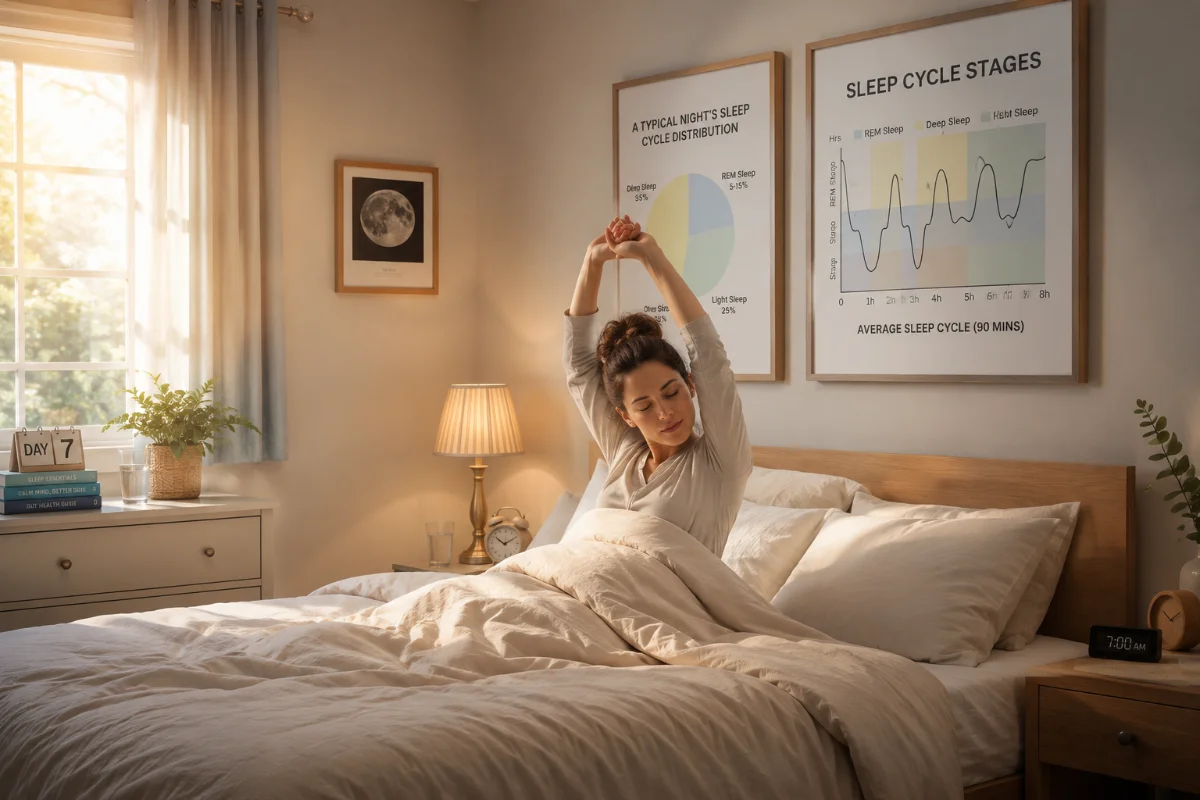
About 45% of adults do not wake up feeling well-rested most days, based on the CDC's 2024 National Health Interview Survey. If that sounds like you, the problem is often not how long you slept. It is where the alarm caught you. The best time to wake up for focus is the point where a sleep cycle ends, not whatever hour you happened to set the alarm for. how long you slept. It is where the alarm caught you. The best time to wake up for focus is the point where a sleep cycle ends, not whatever hour you happened to set the alarm for.
Key Takeaways
- The best time to wake up for focus is the end of a sleep cycle rather than the middle of one. Cycles average around 90 minutes, though they vary.
- Most adults get through four to six cycles a night. Five cycles is about 7.5 hours, which sits inside the 7 to 9 hours recommended for adults.
- Waking out of deep sleep hits you hardest. One study measured a 41% drop in performance straight after waking from slow wave sleep.
- Your sharpest window depends on your chronotype. Late risers score worse in the early morning on both cognitive and physical tests.
- Sleep debt builds quietly. Six hours a night for two weeks produced attention deficits on par with two nights of no sleep, and the people in the study barely noticed.
- Waking at the same time every day matters more than picking a perfect hour.
- A free sleep calculator works backwards from your bedtime to a wake up time, or the other way round.
- A short nap, planned with a nap optimizer, can cover an afternoon dip without eating into that night's sleep.
Why the Best Time to Wake Up for Focus Isn't the Same for Everyone
We got frustrated with the state of sleep advice online. Most of it hands you 6 a.m. as a universal answer, as though everyone runs on identical hardware.
They don't. Your circadian rhythm, the roughly 24-hour internal cycle that sets when you feel alert and when you feel drowsy, is shaped by genetics, age, light exposure and habit.
The clock itself sits in the suprachiasmatic nucleus, a small cluster of around 20,000 neurons in the hypothalamus. It governs core body temperature, hormone release, and the cortisol rise that helps you feel sharp after waking.
So an early chronotype might do their best thinking before 7 a.m. A late chronotype might not get there until mid-morning. One study comparing the two groups found late types performed worse on every cognitive and physical measure tested in the morning. Same test, same time of day, different bodies. You can read more about the thinking behind this approach on our about page.
What holds either way: waking mid-cycle out of deep sleep leaves you foggy whatever the clock says. That fog has a name, sleep inertia, and the worst of it usually clears within 15 to 30 minutes. Mild effects can hang around for an hour or more if you were already short on sleep.
The Science Behind the 90-Minute Sleep Cycle
Sleep is not one flat block. You move through light sleep, deep sleep and REM in a repeating pattern, and the mix shifts as the night goes on. Deep sleep dominates early. REM takes over later.
The Sleep Foundation puts the average cycle at about 90 minutes, though it is messier than that in practice. Your first cycle usually runs 70 to 100 minutes. Later ones stretch to somewhere between 90 and 120. Most healthy adults complete four to six of them across a night.
Five cycles works out at roughly 7.5 hours. Six gets you to 9. Four leaves you at 6, which sits below the range recommended for adults, so treat that as a bad-night floor rather than a target. Getting the count right is most of the answer to "how much sleep do I actually need".
For a broader overview, see our sleep cycle bedtime calculator.
Sources
- Ng AE, Black LI, Adjaye-Gbewonyo D. Short Sleep Duration and Sleep Difficulties Among Adults: United States, 2024. NCHS Data Brief No. 559, April 2026. (54.8% of adults woke up well-rested most days or every day.)
- Sleep Foundation. Stages of Sleep: What Happens in a Normal Sleep Cycle?
- Patel AK, Reddy V, Araujo JF. Physiology, Sleep Stages. StatPearls, NIH.
- Hilditch CJ, McHill AW. Sleep Inertia: Current Insights. Nature and Science of Sleep, 2019.
- Van Dongen HPA, Maislin G, Mullington JM, Dinges DF. The Cumulative Cost of Additional Wakefulness. Sleep, 2003.
- Facer-Childs ER, Boiling S, Balanos GM. The effects of time of day and chronotype on cognitive and physical performance in healthy volunteers. Sports Medicine Open, 2018.
- Tsuno Y, et al. In vivo recording of suprachiasmatic nucleus dynamics. PLOS Biology, 2023. (Approximately 20,000 SCN neurons.)
This article is for general information only and is not medical advice. If you have persistent sleep problems, please speak to a qualified healthcare professional.