
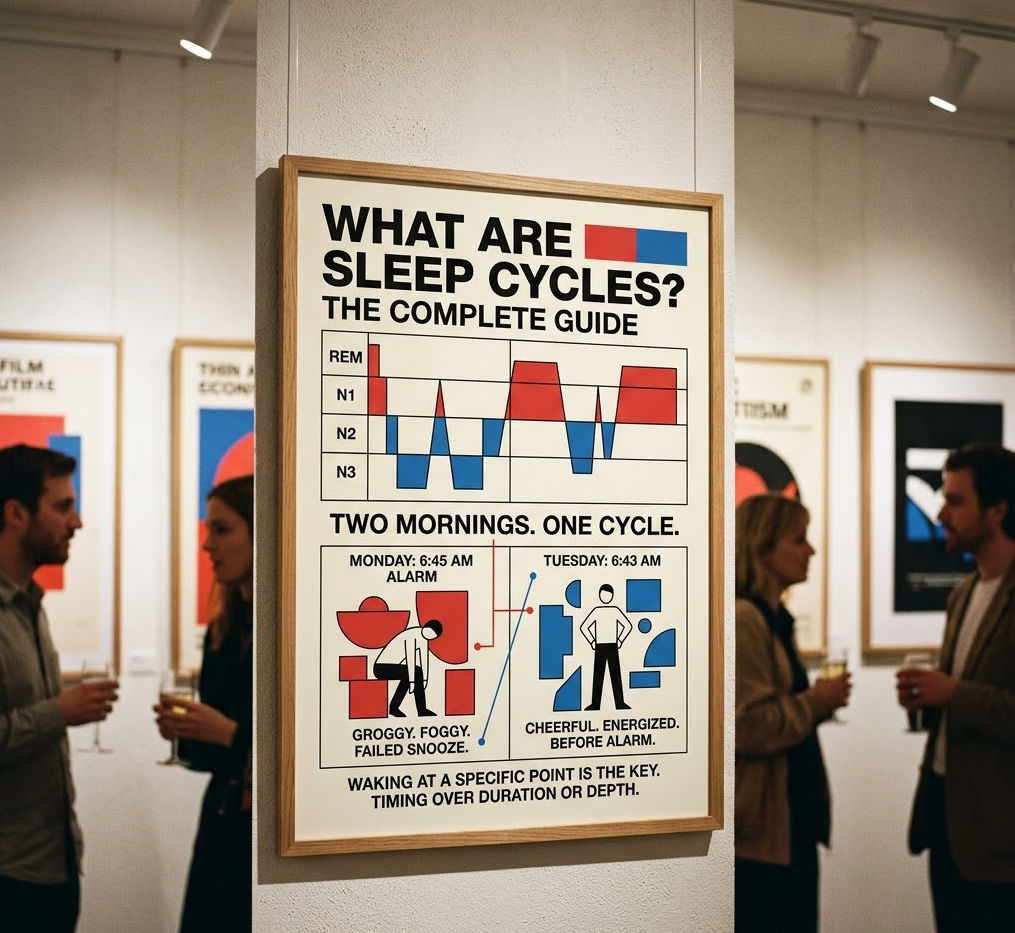
Two mornings. Same person. Very different experience.
Monday: your alarm goes off at 6:45. You hit snooze. The next nine minutes feel slow and heavy. You jab snooze again. When you finally stand up, your head feels foggy, your eyes sting, and your legs are not really cooperating.
Tuesday: same alarm, same hour. Your eyes open at 6:43. You lie there for two minutes, almost cheerful, and you stand up before the alarm even rings.
What changed?
You didn't sleep longer. You didn't sleep deeper. You just happened to wake up at a different point in your sleep cycle. That's the whole difference.
Sleep is not one long flat stretch of unconsciousness. It moves through repeating stages, and where you land at wake-up matters more than most people realise. This guide explains how those stages work, how many cycles you actually need, why cutting them short backfires more than the maths suggests, and how to time your alarm so Monday-style mornings happen far less often.
The 90-Minute Sleep Cycle Explained
A sleep cycle is the loop your brain runs through every night, from light sleep down into deep sleep, then up into REM sleep, then back to lighter sleep before the next cycle starts.
The average length is about 90 minutes. The real range is closer to 70 to 120 minutes, and it varies person to person, night to night, and even cycle to cycle within the same night.
If you sleep for 7.5 hours, you'll typically complete five cycles. Eight hours gives you a little over five. Six hours gets you four if you're lucky.
The cycles repeat through the night, but they don't repeat as identical copies. The early ones are heavy on deep sleep. The later ones are heavy on REM. More on that below. That single fact, by the way, is the reason cutting sleep short hurts more than the lost hours alone would suggest.
The Four Stages of Sleep
Each cycle moves through four stages. Three of them are non-REM (called N1, N2, and N3), and the fourth is REM sleep. Here is what happens in each.
Stage N1 (light sleep, transition)
The drifting-off stage. Your eyes are closed, muscles relax, breathing slows. It usually lasts 1 to 7 minutes. You are easy to wake here, and if someone nudges you, you might insist you weren't asleep at all.
Stage N2 (light sleep)
The bulk of your night. N2 makes up about 45% of total sleep time in healthy adults. Your heart rate drops, body temperature falls, and the brain produces short bursts of activity called sleep spindles, thought to help with memory consolidation.
Stage N3 (deep sleep, slow-wave sleep)
The hard-to-wake stage. Brainwaves slow into long delta waves. Your body releases growth hormone, repairs tissue, strengthens the immune system, and consolidates declarative memory (facts and events). Waking someone out of N3 leaves them confused and groggy for a while; this is the source of severe sleep inertia.
REM sleep (rapid eye movement)
Your brain becomes nearly as active as when you are awake. Your eyes flick under closed lids. Most vivid dreaming happens here. Your body is mostly paralysed, which is a protective feature, not a bug. REM appears to handle emotional processing, creative problem-solving, and some types of learning.
Quick reference table:
| Stage | Type | Typical length per cycle | What happens |
|---|---|---|---|
| N1 | Light | 1 to 7 minutes | Drifting off, easy to wake |
| N2 | Light | 10 to 25 minutes | Slowing down, memory work |
| N3 | Deep | 20 to 40 minutes | Physical repair, memory consolidation |
| REM | Active | 10 to 60 minutes | Dreaming, emotional processing |
How Many Cycles You Need Per Night
Most healthy adults need somewhere between four and six full cycles per night. Five is a sensible default. That works out to around 7.5 hours of sleep, plus a bit of time at the start while you actually fall asleep (usually 10 to 20 minutes).
Need varies a lot by age. General guidelines:
- Newborns (0 to 3 months): 14 to 17 hours per day, including naps
- Infants (4 to 11 months): 12 to 15 hours, including naps
- Toddlers (1 to 2 years): 11 to 14 hours, including naps
- Preschoolers (3 to 5 years): 10 to 13 hours, often still with a nap
- School-age children (6 to 13 years): 9 to 11 hours
- Teenagers (14 to 17 years): 8 to 10 hours
- Adults (18 to 64 years): 7 to 9 hours, roughly 4 to 6 cycles
- Older adults (65+): 7 to 8 hours, though sleep gets lighter and more broken up
These are population ranges, not personal prescriptions. A small number of adults do well on 6 hours; a small number need 9. If you wake up alert without an alarm and feel steady through the afternoon, you're probably getting what you need.
How Cycles Change Across the Night
This is the part most articles leave out. It matters.
Your cycles are not identical. The mix of stages shifts as the night goes on.
- Early night (first two or three cycles): deep sleep dominates. Your first cycle might contain 30 to 40 minutes of N3 and only a brief flash of REM, sometimes just 5 minutes.
- Late night (last two or three cycles): REM dominates. By the final cycle before waking, deep sleep can disappear almost entirely, and REM can stretch to 45 or 60 minutes.
That distribution has a real consequence. If you cut your sleep short on the front end, you lose deep sleep. If you cut it short on the back end, you lose REM. Most people who set a late bedtime and a fixed alarm are sacrificing REM, night after night.
Why this matters in practical terms. Imagine you normally sleep 8 hours and you cut to 6. You lost 25% of your sleep on paper. But because REM is loaded into the final two hours, you may have lost 60 to 80% of your REM. That is why a "small" sleep cut feels disproportionately rough the next day. The cost is not evenly distributed.
Why Sleep Cycles Matter for How You Feel
Two things determine how you feel when you wake up: how much total sleep you got, and where in a cycle you woke up.
Wake at the end of a cycle, in lighter N1 or N2 sleep, and you'll feel alert fairly quickly. Wake in the middle of N3 deep sleep, and you'll experience sleep inertia: that groggy, half-functional state that can last anywhere from 15 minutes to over an hour.
Across a whole night, the cycles matter because each stage does a different job. Deep sleep handles physical restoration and clears metabolic waste from the brain through the glymphatic system. REM handles memory consolidation, emotional regulation, and creative recombination of the day's information. Skip either and the effects show up the next day: foggy thinking, low mood, slower reactions, sugar cravings, irritability. Chronic shortage is linked to higher risk of cardiovascular disease, type 2 diabetes, and cognitive decline.
How to Work With Your Sleep Cycles (Not Against Them)
The simple trick: time your wake-up to land at the end of a cycle, not the middle of one.
Here's the method. Pick a wake time. Count backwards in 90-minute blocks. Add roughly 15 minutes for the time it takes you to fall asleep. That's your target bedtime.
A worked example. You want to wake at 7:00 am.
- 5 cycles back: 11:30 pm. Add 15 minutes for falling asleep. Go to bed at 11:15 pm.
- 6 cycles back: 10:00 pm. Add 15. Bed at 9:45 pm.
- 4 cycles back: 1:00 am. Add 15. Bed at 12:45 am (only if you really must).
Our Sleep Cycle Calculator does this maths for you and offers a few options either side, in case your personal cycle runs slightly shorter or longer than 90 minutes.
A few other practical points:
- Consistency beats perfection. Going to bed at roughly the same time every night, including weekends, trains your body's internal clock and makes the cycle timing more predictable.
- Avoid the snooze button. Hitting snooze starts a new cycle that gets cut off within minutes, which is why those extra nine minutes leave you worse, not better.
- Morning light helps anchor your circadian rhythm, which in turn keeps your cycles regular. Ten minutes outside within an hour of waking is usually enough.
- Caffeine has a half-life of about 5 to 6 hours. A 3pm coffee can still be in your system at bedtime, reducing deep sleep even if you fall asleep fine.
- Alcohol gets you to sleep faster but fragments REM in the second half of the night.
Common Misconceptions About Sleep Cycles
"Sleep cycles are always 90 minutes."
No. Ninety minutes is an average. Individual cycles range from roughly 70 to 120 minutes, vary across the night, and shift slightly with age, fatigue, and even what you ate. Any calculator that promises exact timing is overstating the science. The 90-minute model is a useful guide, not a guarantee.
"More sleep is always better."
Not exactly. Adults regularly sleeping more than 9 hours are statistically associated with higher rates of certain health problems, though cause and effect runs in both directions; sometimes oversleeping is a symptom of an underlying issue. The point: 7 to 9 hours suits most adults best, and pushing well past that is not automatically healthier.
"You can train yourself to need less sleep."
Largely no. The research here is fairly clear. When people cut sleep to 5 or 6 hours over several weeks, they report adapting and feeling fine. Objective tests of reaction time, attention, and memory tell a different story; performance keeps degrading even as the subjective sense of tiredness flattens out. You don't adapt to less sleep. You adapt to feeling tired.
There is a rare genetic variant linked to people who genuinely thrive on 4 to 6 hours, but it affects a tiny percentage of the population. Almost everyone who thinks they have it does not.
When Sleep Cycles Go Wrong
Sometimes the issue is not timing or habits; it's a clinical problem with the cycles themselves.
A few common ones:
- Insomnia: difficulty falling or staying asleep, often resulting in shortened or fragmented cycles.
- Obstructive sleep apnoea: repeated airway collapse causes micro-awakenings, sometimes hundreds per night, that prevent the body from sustaining deep sleep or REM.
- Narcolepsy: REM intrudes into wakefulness, causing daytime sleep attacks and sometimes sudden muscle weakness (cataplexy).
- Restless legs syndrome: uncomfortable sensations and an urge to move the legs that disrupt sleep onset and continuity.
- Circadian rhythm disorders: the body's internal clock is out of sync with the social clock, common with shift work and in some teenagers and older adults.
If you regularly sleep 7 to 9 hours and still wake exhausted, snore loudly, stop breathing during sleep (your partner will usually notice before you do), or fall asleep involuntarily during the day, talk to your GP. Sleep disorders are common, treatable, and worth investigating. Tools and calculators help with timing, but they cannot diagnose a clinical issue.
Key Takeaways
- Sleep moves through repeating cycles of about 90 minutes, with a typical range of 70 to 120 minutes.
- Each cycle includes four stages: N1, N2, N3 (deep sleep), and REM.
- Most adults need 4 to 6 cycles per night; 5 is a good default.
- Deep sleep loads early in the night, REM loads late, so cutting sleep short costs more REM than the lost hours suggest.
- Waking at the end of a cycle feels far better than waking in the middle of one; that's the single most useful thing this guide can give you.
Try It Yourself
Use the Sleep Cycle Calculator to find bedtimes that match a wake-up alarm. Use the Sleep Calculator if you'd rather pick a bedtime and see when to set the alarm. Both tools account for the average cycle length and a typical 15-minute time to fall asleep, and both give you several options to suit nights where your cycle runs a little shorter or longer than usual.